

The Game Pass Series: this series covers games released on Xbox Game Pass, and played on an Xbox Series X
Cost: £0.00 with a Game Pass, £25.00 RRP
Platform: Xbox, Playstation, Mobile, PC (not yet on Steam)
Reviews: 68 out of 100 critic, 8 out of 10 user, review.
Time to complete: 7.5hr main objective, 20hrs+ completionist
Similar Games: You might think other Simulators… not really… more Grand Theft Auto meets Banjo-Kazooie.
Summary
A hybrid of Grand Theft Auto and your usual 3D completionist platformer – e.g. Spyro, Banjo-Kazooie or Mario 64 – Goat Simulator is absurd, chaotic, and frustrating(ly fun).
Game Review
Released in November 2022, I only became aware of its availability whenthe Xbox Game Pass thrust it onto my home page (I try not to read into that…).
A welcome addition to my library, I’m glad to have given the Game Pass some use. With work and other life commitments, it seems to only be serving me as an overpriced Fortnite Multiplayer Subscription.
Of course, given it was acquired via Game Pass, this game was ‘free’ for me to play. You may be surprised to find out that the usual price tag for Goat Simulator 3 is around £25, which from my perspective I would say is a very affordably priced game.
Which begs the question: given it is an open world, quest driven narrative game, why isn’t it a higher price? Most other games RRP for £75 nowadays.
My rationale is that it is full of (mainly intentional) bugs, and sadly while moving in the right direction vs previous editions, Goat Simulator 3 just doesn’t ‘feel’ AAA. £25 is about right. Expect mobile editions to RRP for much, much less.
Gameplay
This is my second time playing Goat Simulator. The last time was on my mobile phone around 2011, and I remember it distinctly had the habit of severely overheating my iPhone 4. After headbutting a petrol station, exploding the car parking lot, and setting my goat on fire – I began to see the phone being hot as simply a extension of the gaming experience.


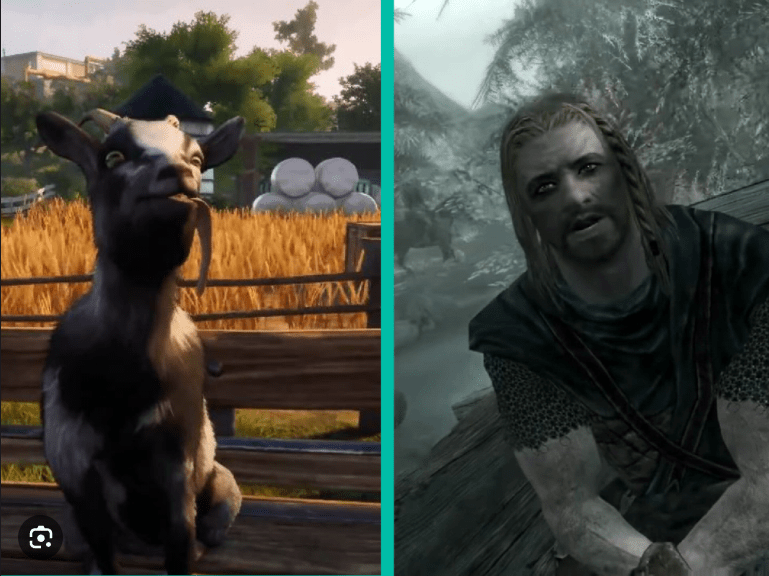
When I fired up Goat Simulator 3, I was pleased to notice an immediate Skyrim-comedic entrance. It’s perfect. A total troll move by the developers and a nod that they mean business. Silliness.
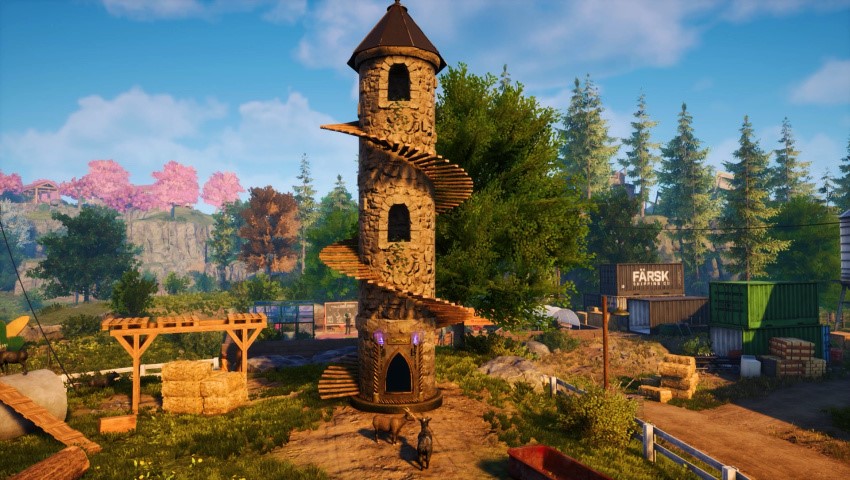
You are then directed towards a core part of the game. The Goat Tower. There are many of these scattered around the open world, and similar to the lookout towers in Assassin’s Creed, they give you visibility of an area and highlight nearby objectives and quests.
Quests
The main quest in the game involves ‘building’ out the tower by completing missions rewarding you with Illuminati points. As you collect points more rooms in the Tower are accessible, eventually leading to the game completion.
The second dynamic of the game are the side quests, these are littered across the map and they have you doing ridiculous things.
One quest had me take down a grandma on a rocking chair firing knitting balls. This was actually quite difficult, her aim is exceptional and she is surprisingly quick and agile. My mother is a ferocious knitter, just without the rocking chair. I’m hoping this isn’t a case of foreshadow.
Another had me collect scarecrows and sacrifice them to a satanic god via a hell circle. Once complete, the scarecrows came to life as tourists. And in classic Goat Simulator-style, just whipped out their iPhones and started taking selfies of the world they had been born into.

An additional quest had me running for President of the island. In order to solicit votes I dragged unwilling members of the public (with my tongue, of course) into voting booths to vote for me.
The last dynamic of the game is a quest-like feature called Instincts. These are your classic ‘collect 10 of X’ or ‘do a backflip’ or ‘climb to the highest point on X’. They serve three purposes:
- They teach your how to play the game.
- They give you an underlying completionist objective. Something to be working towards no matter where you are in the game.
- They can be quite helpful in pointing you in the direction of quests.
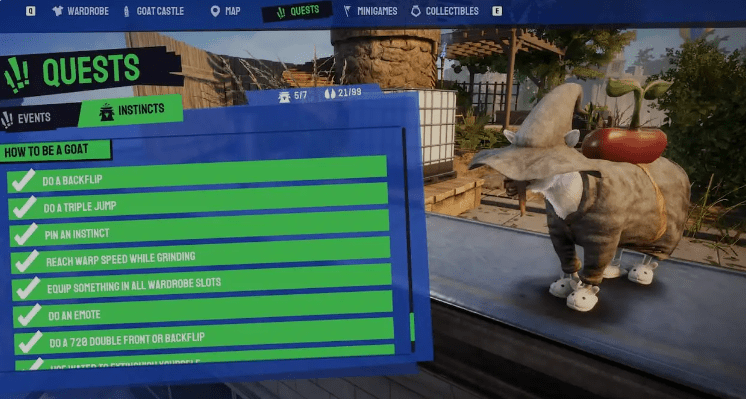
As a player, you tend to flit between messing around, completing quests, or searching/working on instincts.
Mechanics
In order to complete the game and maximise your ability to be a destructive Goat, you need to be familiar with the game mechanics. These at the core are:
- Your Goat can ‘absorb’ elements. For example, you can grease your Goat with oil, set him on fire, or electrocute him. All of these are useful for quests. And destruction.
- Lick. This grabs an item which can then be dragged.
- Climbing/Jumping. Insanely frustrating at times.
- Headbutt. Insanely fun at times.
- Bugs. These are implemented as part of the design of the game.
When using the mechanics, the game recognises that there is a time when humour is the best solution. For example, at the top of the mountain there is a sky diver (complete with parachute, I hasten to add, this isn’t some dark suicidal attempt) patiently waiting on the edge to jump. You could offer him a ride on your back… or give him an unexpected nudge…
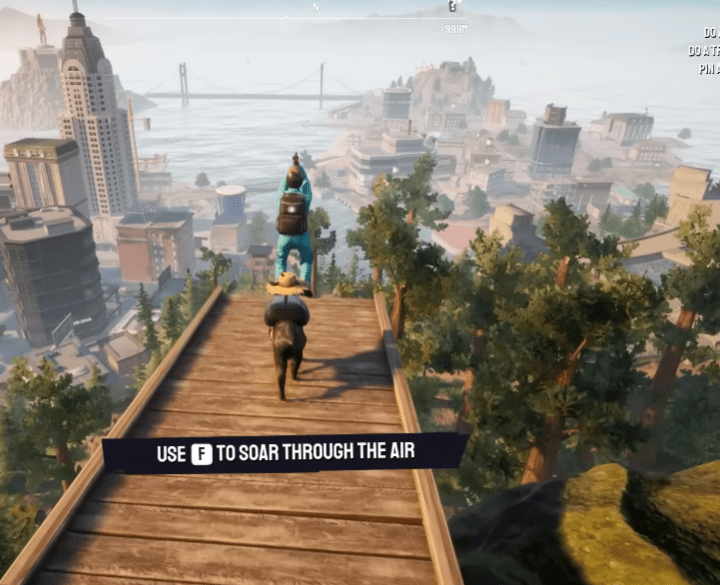
The mechanic out of these that got Goat Simulator its critical acclaim are the Bugs. Often these are oddities, like being flung across the map for no apparent reason.
However, sometimes it is not clear if it a feature/solution or if you’ve just messed the game code. Maybe it’s both?
I had one quest, where after headbutting an air conditioning unit (yes it’s a weird game), I was flung under the map and managed to make my way into a room with the quest award. For this quest I was awarded a totally screwed up version of ‘Bugs’ Bunny as a helmet, which makes me consider: was the bug intentional, or not? I’ve yet to determine if I could have made it into the room without the bug.

Gameplay Summary
My thoughts on the game as a whole? I found myself itching to get back onto the Xbox to explore more of the game while writing this review and watching Youtube videos. It’s hilarious, it’s fun, and it scratches a perennial itch of being a completionist – collecting all the instincts. I love how the game rewards you for trying things e.g. who knew that the window cleaner’s lifts would actually go up and down if you ‘licked’ (it’s a Goat thing) the controller.
It is not the most polished game in the world, and for some it will be convoluted or the jokes won’t hit the spot. For them, I say, BAHHH.
One point I must add. I have yet to play multiplayer but am assured the splitscreen mode is sufficiently full of bugs to be fun. My sister is keen to try it out, having watched me play solo, which I regard as a stellar review for the overall game itself.
The Developers
Goat Simulator is a Swedish game published by Coffee Stain Publishing.
Founded by Swedish university students in 2013 Coffee Stain acquired Gone North Games, and renamed it to Coffee Stain North, before subsequently being acquired by Embracer Group a European conglomerate media company themselves.
It is this studio, Coffee Stain North, who developed of Goat Simulator 3. This studio was also founded by students, but at Sodertorn University around 2012. Their initial game, A Story About My Uncle released in 2014, was developed as part of a competition to build a non-violent first-person game in Unreal Engine. It is at this point they met Coffee Stain Studios, and were eventually fully acquired in 2018.
Sodertorn University is based in a small town called Flemingsberg within the Stockholm County. It is an area of Sweden with an unusual demographic, there are 12,000 inhabitants in Flemingsberg, 12,300 workers, and 13,000 students. For such a small town, it’s incredible the influence a couple students can have by making a game.
It’s also worth highlighting that Video Game culture in Sweden is exceptional, leading to some of the most creative and outstanding studios.
The culture is derived from a number of elements, such as education, technological infrastructure, and government support. But it is also underpinned by a general early acceptance of gaming in Sweden.
I remember playing with Swedish players on Runescape who were at their summer cottages on their long summer holidays, or otherwise sheltering at home from the very cold spring, winter and fall months. Popular culture in Sweden also revered video gamers, such as Basshunter, a popular Swedish EDM artist who wrote songs about video games, being a classic homage to that.

You might be wondering how did these guys begin working on Goat Simulator?
Initially Goat Simulator was developed in house at Coffee Stain Studios as part of a hackathon (‘game jam’) with employees, this was back in 2013. They were inspired and wanted to imitate the famous game QWOP , combined with Tony Hawk Skating, and GTA.

The idea being the game would be silly, difficult, and full of bugs. The result was Goat Simulator 1.
Coffee Stain North then helped work on the GoatZ DLC in 2015, bringing the student team from Sodertorn University into the mix and ultimately working on Goat Simulator 3.
Coffee Stain Studios themselves are famous for a mod for Unreal Tournament 3 called Sanctum. For followers of video games, this is a consistent story re: DOTA, League of Legends, and other mod-born games.
Coffee Stain Studios was acquired in 2018 by Embracer for $34.9m with additional payouts. The number of employees at the business at that time was a cool 45. In November 2020 Embracer finally purchased the last 40% of Coffee Stain North and transitioned it fully under Coffee Stain Studios.
We’re looking forward to seeing what else they produce.

 Fragwire